
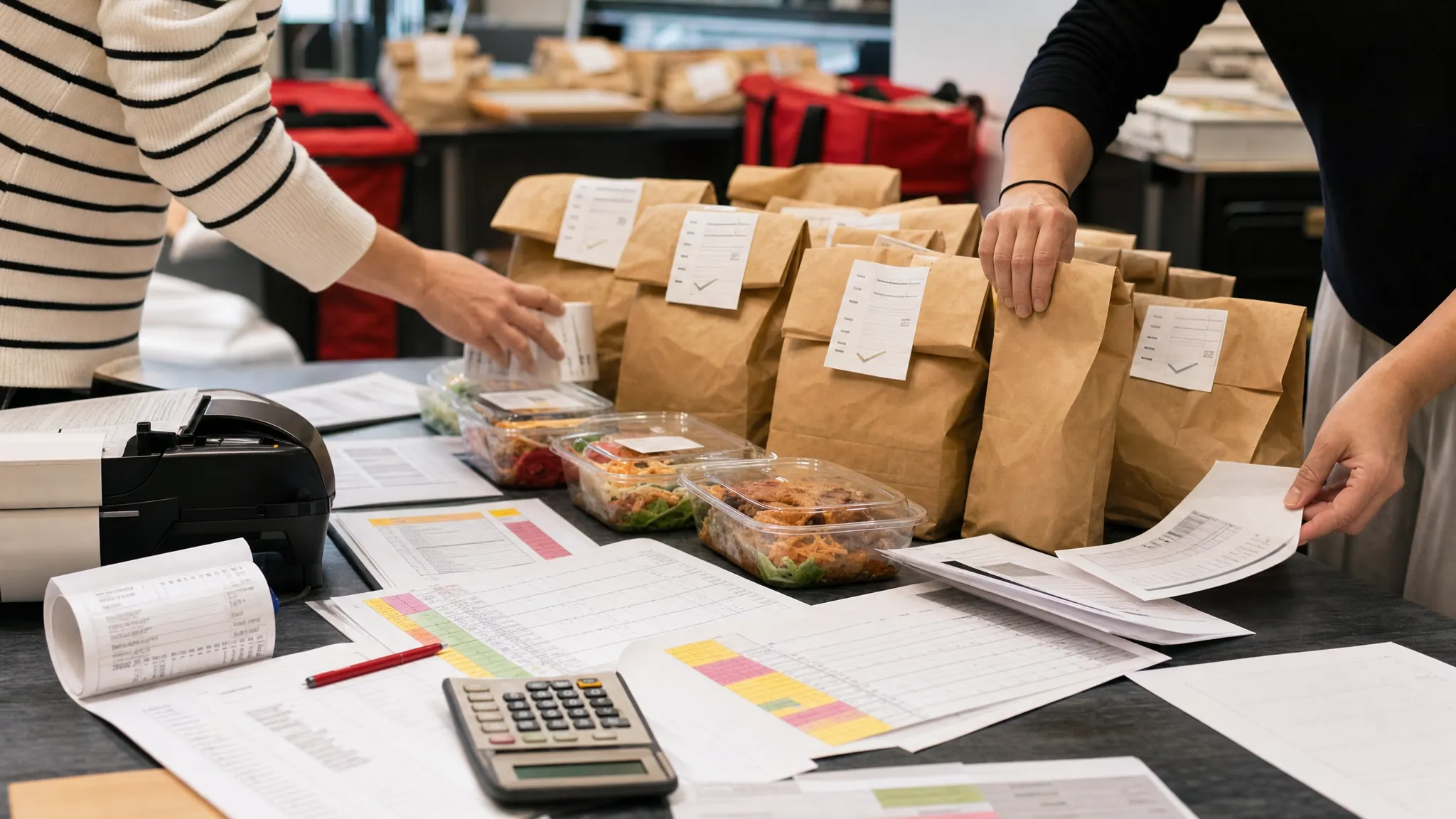
There is no single standard price for private school lunch. The cost depends on whether lunch is included in tuition, run by the school, supplied by a caterer, or ordered from local restaurants. The useful comparison includes the meal price, school subsidy, staff time, and the daily work required to get the right lunch to the right student.
Ask "how much does school lunch cost?" inside a private K-12 school and the honest answer is rarely one tidy price. A public district may talk about paid meal prices, federal reimbursement, and meal debt. A private school is usually looking at a different equation: tuition expectations, parent experience, staff time, vendor reliability, kitchen overhead, and whether lunch has quietly become a cost center.
That distinction matters. Many private schools are not trying to run a public cafeteria program. They are trying to give families a lunch option that feels worthy of the school, works for busy parents, avoids a daily front-office circus, and does not force the school to become a restaurant with a math department attached.
So the useful question is not only "What does each meal cost?" The better question is, "What does this lunch model cost the school, the families, and the day?" That includes food. It also includes ordering, staff time, packaging, delivery, labels, credits, cancellations, absent students, parent questions, and the moment lunch actually lands in the hands of the right child.
Key takeaways
- Private K-12 schools should evaluate school lunch cost as an operating model, not just a meal price.
- Public-school meal prices and reimbursement rates can provide context, but they usually do not describe how private-school lunch is funded or managed.
- An in-house cafeteria can become a real cost center once labor, management, equipment, waste, supplies, and parent support are included.
- Restaurant-prepared lunch can shift the school away from running a food operation, but only if ordering, cutoffs, labels, payments, delivery, and handoff are organized.
- The right comparison is total daily burden: what families pay, what the school subsidizes, what staff must manage, and how cleanly lunch reaches students.
Public lunch prices are not the right benchmark
Public-school lunch prices are useful category context, but they are a weak benchmark for private K-12 planning. For SY 2025-26, the School Nutrition Association reported median paid lunch prices of $3.00 for elementary school, $3.20 for middle school, and $3.25 for high school among surveyed districts that were not serving meals free to all students. SNA's school meal statistics are helpful for understanding the public-school conversation, but they do not tell a private school what its own lunch program should cost.
Public meal prices are shaped by district policy, federal meal programs, eligibility mix, procurement rules, state support, and reimbursement. Those details matter when a school participates in the National School Lunch Program. They matter less when a private school is deciding whether to run an internal kitchen, subsidize lunch through tuition, hire a caterer, or let families order from local restaurants.
The public benchmark can even mislead the conversation. A parent may hear that school lunch costs around three dollars and wonder why a private-school lunch is more. But a private school may be funding labor, food service management, equipment, facilities, ordering systems, packaging, delivery coordination, and staff support without the same public-program structure behind it.
Private-school lunch usually has four cost models
Most private K-12 lunch programs fit into one of four broad models. The price families see depends on which model the school chooses, and the school burden changes dramatically from one model to the next.
Four private-school lunch cost models
Tuition-included lunch
Lunch is treated as part of the school experience. Families do not see a daily meal charge, but the school still pays for food, labor, systems, management, waste, and facilities through the operating budget.
School-run paid lunch
The school operates or manages food service and charges families per meal, per semester, or through a lunch account. This makes pricing clearer, but the school still owns the kitchen and support workload.
Catered or vendor lunch
A third-party provider prepares food for the school. This can reduce internal kitchen work, but the school still needs a clean system for menus, counts, payments, labels, delivery timing, and parent communication.
Restaurant-prepared ordering
Families order ahead from school-approved restaurant options. Restaurants prepare against real orders, and the school needs the right platform to manage cutoffs, payments, delivery, labels, credits, and handoff.
When the school runs lunch, it owns a cost center
An internal lunch program can be a strong fit for some private schools. It gives the school control over menus, service style, ingredient standards, staffing, and the daily rhythm of lunch. That control can be valuable, especially for schools that treat dining as part of the student experience.
But control comes with overhead. A school-run lunch operation has food costs, labor costs, management time, payroll complexity, training, equipment, cleaning, food safety procedures, utilities, point-of-sale or account systems, purchasing, waste, and parent support. If lunch is included in tuition, those costs may disappear from the parent receipt, but they do not disappear from the budget.
This is the part that often gets undercounted. A school may know its food invoice and staffing cost, but not fully measure the admissions expectation, the business-office time, the lunchroom troubleshooting, the parent emails, or the opportunity cost of having school staff manage a food operation. Lunch can become part hospitality, part logistics, part finance, and part weather system. Everyone feels it when it goes sideways.
Tuition-included lunch changes the optics, not the economics
Some private schools include lunch because it supports the brand promise. It can feel premium. It can simplify family life. It can reduce nickel-and-dime friction. For the right school, that can be a smart positioning choice.
The tradeoff is that tuition-included lunch hides the per-meal cost. If participation is high and the program is efficient, that may be fine. If many students skip lunch, waste is high, labor is stretched, or families want more choice, the school may be subsidizing a model that no longer matches demand.
Parent-paid lunch has the opposite tradeoff. Families see the price clearly, which can make value easier to judge. But once parents pay directly, they expect the process to work. They expect menus to be accurate, orders to be correct, credits to make sense, and the school not to shrug when lunch goes missing. Fair enough.
Restaurant-prepared lunch has a different cost shape
Restaurant-prepared lunch is not just "outsourcing food." Done well, it changes the school's role. The school no longer has to build a full lunch operation around forecasting demand, preparing food, staffing kitchens, and managing daily production. Families order ahead, restaurants prepare against real counts, and lunch arrives for school handoff.
That can make the per-meal price look different from a cafeteria tray or a bulk catering order. A restaurant meal includes restaurant ingredients, labor, prep time, packaging, and delivery realities. But the value is not only the meal. The value is avoiding the hidden work that sits around the meal: collecting orders, closing menus on time, matching food to students, handling credits, communicating changes, and keeping the handoff from becoming a hallway treasure hunt.
The model only works if the operating layer is strong. A private school should not have to become the coordinator between every parent and every restaurant. The platform has to manage the boring details: order cutoffs, school-specific menus, payment status, student identifiers, delivery timing, labels, absent students, credits, and restaurant prep counts. Boring details are where lunch programs either make money, lose money, or make everyone regret Tuesday.
What private schools should include in a cost review
A practical private-school lunch cost review should compare the full operating model. Start with the meal price, then keep going.
- What does the family pay, and is that payment daily, monthly, semester-based, or built into tuition?
- How much does the school subsidize through tuition, fundraising, or the operating budget?
- Who owns food-service labor, management, training, cleaning, equipment, and supplies?
- How much staff time is spent answering lunch questions, fixing orders, and managing credits?
- How are menus, cutoffs, allergens, labels, rosters, and student identifiers handled?
- How accurate are order counts before food is prepared?
- What happens when a student is absent, a delivery is late, or a meal is missing?
- Does the model improve parent satisfaction, or does it create another help-desk queue?
- Can the model scale from a small pilot to the full school without adding daily staff burden?
That last question is the quiet killer. A lunch solution can look tidy for twenty orders and collapse at two hundred. A private school does not just need food to show up. It needs lunch to show up in a way that protects the school day, respects the parent experience, and does not turn administrators into part-time expediters.
A useful private-school lunch scorecard
When private schools compare lunch options, the cleanest scorecard has three columns: family cost, school cost, and operational load. Family cost is the visible price parents feel. School cost is the subsidy, staffing, management, and support the school absorbs. Operational load is the daily work that appears when orders are wrong, late, unlabeled, unpaid, or unclear.
A tuition-included cafeteria may score well on family simplicity but poorly on budget visibility. A low-cost bulk catering model may look efficient but frustrate families if the food feels repetitive or the school has to manage constant substitutions. A restaurant-ordering model may have a higher visible meal price, but it can score better on choice, demand accuracy, and avoiding internal food-service expansion when the ordering layer is strong.
The best answer depends on what the school is trying to protect. If the goal is a premium all-included campus experience, the school may willingly carry more cost internally. If the goal is parent choice without more school staffing, a parent-paid restaurant model may be cleaner. If the goal is the lowest possible meal price, the school should be honest about what quality, variety, and staff time it is giving up to get there.
This is also where private schools should separate "cheap" from "sustainable." Cheap means the number looks low today. Sustainable means the school can run the model every week without burning staff time, disappointing families, confusing vendors, or hiding the cost somewhere else. Lunch does not need to be fancy. It does need to stop stealing attention from the school day.
Use public data as context, not the decision
If a private school participates in a federal meal program, then federal reimbursement, eligibility, and program rules matter. The USDA and Federal Register publish annual reimbursement information, and those numbers are important for schools operating inside that system. The Federal Register reimbursement notice is the official source for the SY 2025-26 national average payment rates.
But for many private schools, the more immediate decision is not a reimbursement calculation. It is whether lunch should be a school-run operation, a tuition-funded amenity, a parent-paid service, a catered program, or a restaurant-prepared ordering model. Public data can help explain the broader category. It should not be allowed to drag a private-school strategy into the wrong room.
For broader sourced context, the Buy My Lunch school lunch statistics page tracks participation, costs, debt, food waste, lunch timing, and other category numbers. Private schools comparing actual operating options should also review the private school lunch catering page and the online lunch ordering for schools guide.
How Buy My Lunch fits private K-12 lunch cost
Buy My Lunch is built for schools that want better lunch without owning every food-service headache. Families order ahead from the school-specific restaurant options available to them. Restaurants receive organized orders instead of guesses. Payments, credits, cutoffs, labels, delivery details, and handoff steps stay connected.
For private K-12 schools, that matters because lunch is not only a food decision. It is part of the parent experience. It is part of operations. It is part of how the school day feels. A lunch model that saves the school from running a bigger internal cost center, gives families more appealing choices, and keeps handoff organized can be worth comparing differently from a simple tray price.
The goal is not to make lunch seem cheap. The goal is to make the cost make sense. Private schools do not need another lunch program that looks fine on a spreadsheet and gets weird at 11:47 a.m. They need a model where the price, workflow, and parent experience all point in the same direction.
Frequently asked questions
How much does private school lunch cost?
Private school lunch cost depends on the model. Some schools include lunch in tuition, some charge families per meal, some operate a cafeteria, some use caterers, and some work with local restaurants through an ordering platform. The useful number is not only the meal price. It is the full cost of food, labor, systems, delivery, parent support, credits, and handoff.
Why is private school lunch different from public school lunch?
Private schools are often solving a different problem. Public-school lunch conversations frequently involve federal reimbursement, free and reduced-price eligibility, and district policy. Private K-12 schools are more often comparing parent experience, tuition expectations, campus operations, vendor reliability, and whether the school wants to run food service as an internal cost center.
Should a private school include lunch in tuition?
Including lunch in tuition can make the parent experience feel simpler, but it hides the true lunch cost inside the school's operating budget. That can work when participation is high and the model is tightly managed. If costs, waste, staffing, or parent preferences vary widely, a parent-paid model may make the economics clearer.
Is a restaurant-based lunch program more expensive?
A restaurant-based lunch program can look more expensive if the only comparison is the price of a single meal. The better comparison is total workflow. If restaurants prepare against real orders and the platform handles cutoffs, payments, labels, credits, and delivery details, the school may avoid the overhead of running or expanding its own lunch operation.
What should private schools compare before choosing a lunch solution?
Private schools should compare meal quality, parent payment flow, tuition impact, staff time, ordering deadlines, allergen notes, labels, delivery windows, refunds, credits, absent students, vendor accountability, and the daily handoff. A cheap meal is not cheap if the front office has to rescue lunch every day.
How does Buy My Lunch help private K-12 schools manage lunch cost?
Buy My Lunch helps private K-12 schools offer restaurant-prepared lunch without turning the school into the restaurant. Families order ahead, restaurants receive organized counts, payments and credits stay connected, meals arrive labeled, and schools get a cleaner handoff.
Related posts
 School Lunch OperationsSchool Lunch Program Benefits That Matter Every Day
School lunch program benefits go beyond the meal: clearer routines for families, a steadier school day, and a more workable plan for the teams serving lunch.
 School Lunch OperationsSchool Lunch Ordering Cutoffs: A Practical Guide
A practical guide to setting school lunch ordering cutoffs that give families clarity, restaurants time to prepare, and schools a reliable handoff.
 School Lunch OperationsSchool Lunch Payment Integration: What Schools Should Ask
A practical guide to connecting school lunch ordering and payment without leaving families, staff, or restaurant partners to reconcile lunch-day loose ends.